

Sustainability · 2025
In this section48 topics
- Sustainability Policy4 items
- Sustainability Goals & UN SDGs3 items
- Policy Review2 items
- Business Value Chain1 item
- Stakeholder Analysis2 items
- Environmental Policy & Guidelines5 items
- Environmental Policy Review2 items
- Energy — Plan & Guidelines2 items
- Energy — Electricity Consumption1 item
- Energy — Fuel Consumption1 item
- Energy — Targets1 item
- Energy — Performance & Outcomes2 items
- Water — Plan & Guidelines2 items
- Water — Withdrawal, Discharge & Consumption1 item
- Water — Targets1 item
- Water — Performance & Outcomes2 items
- Waste — Plan & Guidelines2 items
- Waste — Generation, Disposal & Recycling1 item
- Waste — Targets1 item
- Waste — Performance & Outcomes2 items
- GHG — Plan & Guidelines2 items
- GHG — Emissions1 item
- GHG — Emissions Verification1 item
- GHG — Principles & Standards1 item
- GHG — Targets1 item
- GHG — Performance & Outcomes2 items
- Environmental Legal Incidents1 item
- Social Policy & Guidelines5 items
- Social Policy Review2 items
- Human Rights Due Diligence2 items
- Employees — Plan & Guidelines3 items
- Employees — Workforce3 items
- Employees — Remuneration & Provident Fund2 items
- Employees — Training & Development2 items
- Employees — Occupational Health & Safety2 items
- Employees — Labour Relations2 items
- Employees — Employee Representation2 items
- Employees — Targets2 items
- Employees — Performance & Outcomes2 items
- Customers — Plan & Guidelines3 items
- Customers — Satisfaction Results1 item
- Customers — Targets1 item
- Customers — Performance & Outcomes2 items
- Community & Social — Plan & Guidelines3 items
- Community & Social — Targets1 item
- Community & Social — Performance & Outcomes2 items
- Other Social Management1 item
- Law Violation Incidents1 item
Sustainability Policy
Has a Sustainability Policy
Yes
Policy Description
The company is committed to creating value for the organization while taking into account the best interests of all stakeholder groups. It adheres to ethical management principles and good corporate governance practices, and conducts its business with responsibility. This commitment is reflected in the Company’s vision: to operate with integrity in order to contribute to social stability, to provide valuable and high-quality protection to policyholders and stakeholders, and to strengthen its position as a leading company in the non-life insurance industry. The Company upholds four core values: innovation, a strong sense of responsibility, collaboration, and service excellence—while taking into consideration the social and environmental impacts related to its business.
In 2025, the Board of Directors reviewed and approved the Sustainability Policy for continued implementation, consistent with the previous year, to ensure ongoing and consistent execution. The Board also determined that the current policy remains aligned with the Company’s strategy, business plan, and long-term objectives. The purpose is to foster awareness and confidence that the Company’s operations generate economic, social, and environmental benefits, reflecting various Sustainable Development Goals simultaneously. In addition, the Board of Directors has established a sustainability framework covering economic, social, and environmental dimensions. On the economic dimension, the Company focuses on conducting business transparently in accordance with good corporate governance principles and its code of conduct, respecting the rights of and treating all stakeholder groups fairly, and enhancing the value of its products and services. On the social dimension, the Company remains committed to improving knowledge and understanding of insurance and expanding access channels to insurance products. It also ensures fair treatment of employees, who are considered a key resource of the Company. On the environmental dimension, the Company is committed to conducting its business with environmental responsibility, improving work processes and products through the application of innovation and modern technology, and fostering environmental awareness among its personnel.
The Board of Directors has also established a sustainability commitment: “Providing the agile protection for a stable lifves.”
Policy Document Link
https://www.navakij.co.th/public/core/uploaded/documents/files/558/e0840d7429767f7409d47899f2748b4e.pdf
Page Number in Report
1-2
Sustainability Goals & UN SDGs
Has Sustainability Goals
No
Goals Description
At present, however, the Company has already enhanced its operations to align with its Sustainability Policy. These initiatives include reducing the consumption of resources and energy, promoting resource reuse, improving waste management practices, and developing value-added products, etc.
UN Sustainable Development Goals
| SDG Goal |
|---|
| Goal 3 Good Health and Well-being |
| Goal 4 Quality Education |
| Goal 8 Decent Work and Economic Growth |
| Goal 10 Reduce Inequalities |
| Goal 11 Sustainable Cities and Communities |
| Goal 12 Responsible Consumption and Production |
| Goal 17 Partnerships for the Goals |
Policy Review
Policy Reviewed This Year
Yes
Policy Changed This Year
No
Business Value Chain
Value Chain Description
The Company primarily engages in the business of providing all types of non-life insurance. The main activities in the value chain include designing and developing policies, carefully underwritten, providing convenient and prompt services, and fairly assessing claims. The Company is committed to modernizing the organization while emphasizing social responsibility. Therefore, it continuously develops new innovations to keep up with societal changes and meet the needs of consumers in the digital age. The information on the main activities in the Company's value chain is as follows:
Key activities
Value chain | Activities | Stakeholders |
Production factors management |
|
|
Operations |
|
|
Distribution of goods and services |
|
|
Marketing and sales |
|
|
After-sales service |
|
|
Supporting activities
Value Chain | Activities | Stakeholders |
Production factors management |
|
|
Technology development |
|
|
Human resource development |
|
|
Infrastructure |
|
|
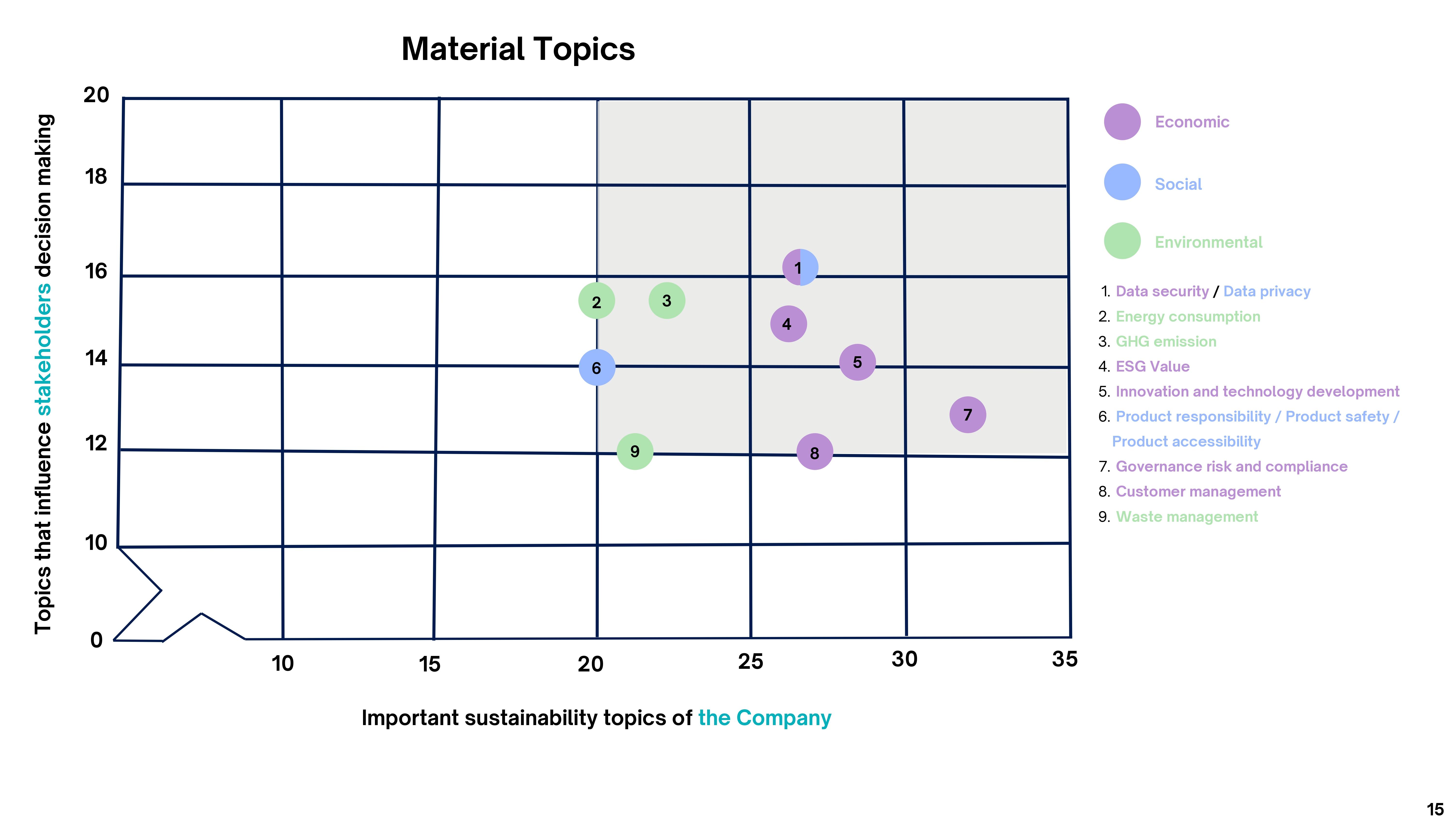
Prioritizing and identifying key sustainability issues
The Company analyzed the expectations of stakeholders in both positive and negative impacts to prioritize and identify key sustainability issues as follows:
Stakeholder Analysis
Introduction
The Company clearly sets policies and guidelines for treating each group of stakeholders with awareness of the importance and respect for the rights of stakeholders who are involved or affected by the Company's operations both directly and indirectly. The Company also provides communication channels and stakeholder engagement activities, enabling the Company to get opinions, concerns, expectations, and new perspectives. Those issues shall be benefit for improving the efficiency of the Company's business operations.
The stakeholder engagement is established for each stakeholder group in different forms as follows:
Stakeholder Analysis
| Stakeholder Type | Stakeholders | Stakeholder Expectations | Response to Expectations | Communication Activities |
|---|---|---|---|---|
| External stakeholders | 2913 · Description: Shareholders | - Good profit and returns
- Business operations according to the principles of good corporate governance
- Stable and sustainable business growth
- Complete and timely information disclosure
| - Consistently pay dividends in line with operating results
- Operate the business in accordance with the principles of good corporate governance and sustainable development
- Disclose complete information as required by law.
| 2941 · Description: Online Communication · 2944 · Description: Annual General Meeting (AGM) |
| External stakeholders | 2923 · Description: Customers | - Variety of coverage of insurance that meets customer needs at reasonable price
- Good service and fast response to customer needs
- Security of personal information
| - Design products with reasonable prices and a wide range of options
- Organize a Customer Relations Division to serve the customers and receive complaints
| 2941 · Description: Online Communication · 2945 · Description: Complaint Reception · 2947 · Description: Satisfaction Survey |
| External stakeholders | 2899 · Description: Suppliers | - Compliance with commercial contact properly, transparently and fairly
- Convenient and fast coordination and services
- Efficient and uncomplicated system and workflow
- Competitive premiums
| - Make an agreement regarding mutual benefits and strictly comply with commercial contract
- Determine clear process and timeframes for the procedure
- Provide convenient and fast coordination and services
- Periodically communicate progress of proceedings
| 2938 · Description: Visit · 2948 · Description: Training / Seminar |
| Internal stakeholders | 2921 · Description: Employees | - Proper compensation and benefits
- Stability and career path
- Knowledge and ability development
- Work and life balance
- Response to factors affecting work motivation
- Equality and fair treatment
- Good working environment
| - Determine appropriate and adequate compensation and benefits comparable to businesses in the same industry.
- Provide continuous training plans for professional development and growth.
- Set guidelines for reducing pressure and increasing work efficiency.
- Treat the Company's employees fairly according to personnel management regulations.
- Establish workplace safety practices including creating a good working environment.
| 2940 · Description: Social Event · 2941 · Description: Online Communication · 2945 · Description: Complaint Reception · 2947 · Description: Satisfaction Survey · 2948 · Description: Training / Seminar |
| External stakeholders | 2898 · Description: Competitors | - Fair trade competition | - Competing in trade according to rules and business etiquette | 2941 · Description: Online Communication |
| External stakeholders | 2894 · Description: Creditor | - Timely repayment of debt | - Strictly follow agreement | 2942 · Description: Internal Meeting · 2943 · Description: External Meeting |
| External stakeholders | 2902 · Description: Community · 2928 · Description: Society | - Social and environmental responsibility | - Raise awareness among employees to care about society and the environment
- Organize activities to help society and the environment
| 2940 · Description: Social Event |
| External stakeholders | 2931 · Description: Government agencies and Regulators | - Comply with the requirements correctly
- Cooperates and support various projects | - Communicate to employees regarding laws, rules, regulations and urge to strictly comply
- Promote good cooperation between departments
| 2941 · Description: Online Communication · 2942 · Description: Internal Meeting |
Environmental Policy & Guidelines
Has an Environmental Policy
Yes
Policy Description
The Company operates primarily in the non-life insurance service business, which does not involve manufacturing processes that directly cause significant environmental impacts. Nevertheless, the Company recognizes the importance of efficient and responsible resource utilization in its business operations to support environmental sustainability and long-term sustainable growth.
The Company has therefore established the following environmental policy and practices:
Compliance with Applicable Laws and Requirements
The Company is committed to strictly complying with applicable environmental laws, regulations, and obligations, as well as relevant agreements with customers, business partners, and stakeholders.Awareness Building and Communication
The Company continuously communicates and promotes its environmental policy to employees in order to raise awareness of their roles and responsibilities in environmental conservation, including reducing resource consumption and encouraging appropriate reuse practices.Efficient Use of Energy and Resources
The Company emphasizes the efficient and prudent use of energy and resources to prevent and minimize potential adverse environmental impacts arising from its activities, products, and services.Environmentally Friendly Resource Utilization and Waste Management
The Company supports the responsible and efficient use of environmentally friendly energy and resources and promotes effective and appropriate waste management practices.Continuous Improvement to Address Climate Change Impacts
The Company seeks to improve operational processes and adopt energy-efficient equipment to mitigate climate change impacts and reduce greenhouse gas emissions associated with energy and resource consumption.
Policy Document Link
https://www.navakij.co.th/public/core/uploaded/documents/files/559/5a2e27b8bf1726fdb6d98fb151064024.pdf
Page Number in Report
1
Environmental Guidelines
| Guideline |
|---|
| Electricity Management |
| Fuel Management |
| Water Management |
| Waste Management |
Environmental Policy Review
Policy Reviewed This Year
Yes
Review Details
The Board of Directors has reviewed the Environmental Policy and determined that it remains appropriate. Therefore, no material changes have been made.
Energy — Plan & Guidelines
Has an Energy Management Plan
No
Plan Description
The Company recognizes the importance of efficient energy utilization and has continuously promoted energy-saving practices within the organization. Key initiatives include encouraging employees to switch off electrical equipment when not in use, controlling air-conditioning systems in line with office hours, replacing electrical equipment with energy-efficient alternatives, promoting digital workflows to reduce resource consumption and raising employee awareness regarding energy conservation.
Given that the Company operates a service-based business with energy consumption primarily limited to office operations and without energy-intensive production processes, the level of energy usage is not considered material to the Company’s overall business operations. As such, the Company has not yet established a formal energy management plan or quantitative energy reduction targets.
Nevertheless, the Company will continue to monitor its energy consumption and assess the appropriateness of developing more structured energy management measures in alignment with the scale of its business operations and the materiality of energy usage.
Energy — Electricity Consumption
Electricity Consumption
| Metric | Current Year | Previous Year | Two Years Ago |
|---|---|---|---|
| Total electricity consumption within the organization (Kilowatt-Hours) | 561,051 | 619,814 | 613,097 |
| Electricity purchased for consumption from non-renewable energy sources (Kilowatt-Hours) | |||
| Electricity purchased or generated for consumption from renewable energy sources (Kilowatt-Hours) |
Energy — Fuel Consumption
Fuel Consumption
| Metric | Current Year | Previous Year | Two Years Ago |
|---|---|---|---|
| Crude oil (Barrels) | |||
| Coal (Metric tonnes) | |||
| Jet fuel (Litres) | |||
| Diesel (Litres) | 6,550.01 | 7,340.5 | 6,026.2 |
| Gasoline (Litres) | 20,711.38 | 21,182.09 | 23,668.72 |
| Fuel oil (Litres) | |||
| Natural gas (Standard cubic feet) | |||
| LPG (Kilograms) | |||
| Steam (Metric tonnes) |
Energy — Targets
Has Set Targets
No
Energy — Performance & Outcomes
Has Performance Results
No
Performance Description
The Company recognizes the importance of efficient energy management in the conduct of its non-life insurance business. The Company’s primary sources of energy consumption arise from office building operations, information technology systems, and fuel used for company vehicles.
While the Company has not yet established a quantitative energy reduction target, it has continuously implemented measures to enhance energy efficiency and monitor energy consumption. The Company is currently developing a structured energy data management system to support the establishment of a base year and future measurable targets.
As the Company operates within an office condominium building, it is not in a position to directly install on-site renewable energy systems such as solar rooftop panels. Nevertheless, the Company focuses on optimizing energy use within areas under its operational control.
During the past three years (2023–2025), diesel consumption increased in 2024 compared to 2023; however, in 2025 diesel usage decreased by approximately 10.8% compared to 2024. Gasoline consumption has shown a consistent downward trend, declining by approximately 12.5% from 2023 to 2025. Electricity consumption in 2025 decreased by approximately 9.5% compared to 2024 and by approximately 8.5% compared to 2023, reflecting improved energy management efficiency.
Looking ahead, the Company plans to formalize its energy baseline and consider setting quantitative energy reduction targets. The Company will also evaluate feasible alternative energy solutions and greenhouse gas mitigation measures that are appropriate within the constraints of operating in a shared office building environment.
Water — Plan & Guidelines
Has a Water Management Plan
No
Plan Description
The Company recognizes the importance of efficient water utilization and has continuously promoted water conservation awareness among employees. The Company encourages responsible water usage practices within its office premises and supports initiatives aimed at reducing water consumption.
Given that the Company operates a service-based business, with water usage primarily limited to office activities and without water-intensive production processes, water consumption is not considered material to the Company’s overall operations. Accordingly, the Company has not established a formal water management plan or set quantitative water reduction targets.
Nevertheless, the Company will continue to monitor its water consumption on a regular basis and assess the appropriateness of developing more structured water management measures in alignment with the scale of its operations and the level of impact.
Water — Withdrawal, Discharge & Consumption
Water Withdrawal, Discharge & Consumption
| Metric | Current Year | Previous Year | Two Years Ago |
|---|---|---|---|
| Total water withdrawal (Cubic meters) | 5,351 | 5,542 | 6,012 |
| Total water withdrawal by third-party water (Cubic meters) | |||
| Total water withdrawal by surface water (Cubic meters) | |||
| Total water withdrawal by groundwater (Cubic meters) | |||
| Total water withdrawal by seawater (Cubic meters) | |||
| Total water withdrawal by produced water (Cubic meters) | |||
| Percentage of wastewater treated before discharge (%) | |||
| Total water discharge (Cubic meters) | |||
| Total water discharge to third-party water (Cubic meters) | |||
| Total water discharge to surface water (Cubic meters) | |||
| Total water discharge to groundwater (Cubic meters) | |||
| Total water discharge to seawater (Cubic meters) | |||
| Total water consumption (Cubic meters) | |||
| Recycled water (Cubic meters) |
Water — Targets
Has Set Targets
No
Water — Performance & Outcomes
Has Performance Results
No
Performance Description
The Company recognizes the importance of efficient water resource management, although water consumption is not a primary factor in its non-life insurance operations. The Company’s water usage mainly arises from office activities, such as consumption and sanitary purposes.
The Company operates within an office condominium building, where the wastewater treatment system is managed by the building’s management. Therefore, the Company does not have its own wastewater treatment or disposal system. Nevertheless, the Company places importance on the appropriate use of water within areas under its operational control.
Although the Company has not established a quantitative target for water reduction, it has continuously promoted employee awareness regarding water conservation.
Over the past three years (2023–2025), the Company’s water consumption has shown a continuous downward trend. Water usage in 2025 decreased by approximately 11.0% compared to 2023 and by approximately 3.4% compared to 2024, reflecting improved efficiency in water resource management.
Waste — Plan & Guidelines
Has a Waste Management Plan
Yes
Plan Description
The Company recognizes the importance of proper waste management as part of its environmental responsibility. Although the Company operates a service-based business and does not generate industrial waste from production processes, waste arising from office activities is managed in a systematic and appropriate manner.
The Company has implemented a waste segregation program by categorizing waste into four types: aluminum waste, recyclable waste, hazardous waste, and general waste. Each category is collected and disposed of or recycled through appropriate channels to ensure compliance with applicable laws, regulations, and environmental standards.
This practice has been continuously implemented since 2025, reflecting the Company’s commitment to promoting efficient resource utilization and minimizing environmental impacts from office operations. In addition, the Company encourages employees to actively participate in waste segregation and responsible consumption practices to enhance environmental awareness within the organization.
The Company will continue to review and improve its waste management practices to ensure alignment with the scale of its operations and its sustainability objectives.
Waste — Generation, Disposal & Recycling
Waste Generation, Disposal & Recycling
| Metric | Current Year | Previous Year | Two Years Ago |
|---|---|---|---|
| Total waste generated (Kilograms) | 19,488 | 29,900 | 18,200 |
| Non-hazardous waste (Kilograms) | 19,488 | 29,900 | 18,200 |
| Non-hazardous waste - Landfilling (Kilograms) | |||
| Non-hazardous waste - Incineration (with energy recovery) (Kilograms) | |||
| Non-hazardous waste - Incineration (without energy recovery) (Kilograms) | |||
| Non-hazardous waste - Other disposal operations (Kilograms) | |||
| Hazardous waste (Kilograms) | |||
| Hazardous waste - Landfilling (Kilograms) | |||
| Hazardous waste - Incineration (with energy recovery) (Kilograms) | |||
| Hazardous waste - Incineration (without energy recovery) (Kilograms) | |||
| Hazardous waste - Other disposal operations (Kilograms) | |||
| Total reused/recycled waste (Kilograms) | |||
| Reused/Recycled non-hazardous waste (Kilograms) | |||
| Reused non-hazardous waste (Kilograms) | |||
| Recycled non-hazardous waste (Kilograms) | |||
| Reused/Recycled hazardous waste (Kilograms) | |||
| Reused hazardous waste (Kilograms) | |||
| Recycled hazardous waste (Kilograms) |
Waste — Targets
Has Set Targets
No
Waste — Performance & Outcomes
Has Performance Results
No
Performance Description
The Company recognizes the importance of proper waste management, although the nature of its non-life insurance business does not involve industrial production processes that generate manufacturing waste. The Company’s primary waste consists of office-related waste, such as paper, packaging materials, and general waste from employee consumption.
The Company operates within an office condominium building, where waste collection, transportation, and disposal are managed by the building management. Nevertheless, the Company emphasizes waste reduction at the source and promotes waste segregation practices within areas under its operational control.
In 2024, the Company’s total waste increased significantly compared to 2023. In response, the Company implemented waste management measures, including promoting Digital Workflow to reduce paper consumption, encouraging waste segregation within the office, reducing the use of single-use materials, and raising employee awareness of waste reduction. As a result, in 2025, the Company’s total waste decreased by 34.82% compared to 2024. Waste volume is correlated with the number of employees and the level of business activities in each year.
The Company will continue to monitor waste generation data to support the establishment of appropriate waste reduction targets aligned with its organizational context in the future, and to further enhance resource management efficiency in line with its sustainable business practices.
GHG — Plan & Guidelines
Has a GHG Management Plan
No
Plan Description
The Company has continuously collected and monitored greenhouse gas (GHG) emission data from its operational activities in order to identify key emission sources and support appropriate management measures.
Given that the Company operates a service-based business without energy-intensive production processes, greenhouse gas emissions across Scope 1, Scope 2, and Scope 3 are not considered material relative to the nature and scale of its operations. The primary emission sources are associated with electricity consumption in office operations and indirect energy use from business support activities.
Although the overall level of emissions is not significant, the Company remains committed to regularly monitoring its GHG data to assess trends and identify opportunities for improving energy efficiency. The Company also promotes resource conservation practices within the organization. The appropriateness of establishing formal reduction targets or additional measures will be considered in alignment with the materiality of emissions.
GHG — Emissions
GHG Emissions
| Metric | Current Year | Previous Year | Two Years Ago |
|---|---|---|---|
| Total GHG emissions (Metric tonnes of carbon dioxide equivalent) | 460 | 717 | 879 |
| Total greenhouse gas emissions 1 (Metric tonnes of carbon dioxide equivalent) | 59 | 106 | 266 |
| Total greenhouse gas emissions 2 (Metric tonnes of carbon dioxide equivalent) | 401 | 447 | 415 |
| Total greenhouse gas emissions 3 (Metric tonnes of carbon dioxide equivalent) | 0 | 164 | 198 |
GHG — Emissions Verification
Emissions Verified by a Third Party
No
GHG — Principles & Standards
Principles & Standards Applied
| Standard |
|---|
| 2671 |
GHG — Targets
Has Set GHG Targets
No
GHG — Performance & Outcomes
Has Performance Results
No
Performance Description
The Company recognizes the importance of greenhouse gas management as part of its response to climate change, which may affect the non-life insurance business in terms of both the frequency and severity of disaster-related risks. Therefore, the Company continuously monitors and assesses greenhouse gas emissions arising from its business operations.
Greenhouse gas emissions under Scope 1, which represent direct emissions from the Company’s operations, have decreased significantly. This reduction is partly attributable to improvements in the data collection methodology, which may have contained inaccuracies in previous years, and partly due to more efficient energy and resource management.
For Scope 2 emissions, which represent indirect emissions from electricity consumption, the emission level has remained relatively stable. In 2025, the amount slightly decreased compared with 2024.
Regarding Scope 3 emissions, which cover other indirect emissions across the value chain, the Company began collecting additional activity data in 2025 to improve the coverage of such emissions. However, the Company is currently in the process of developing appropriate calculation methodologies and emission factors. Therefore, the emissions have not yet been calculated and disclosed in terms of tons of carbon dioxide equivalent (tCO2e). The Company will continue to enhance its data collection and calculation systems in the future.
The Company aims to further improve its environmental data management system to ensure greater completeness and alignment with international standards, in order to support the development of greenhouse gas reduction measures and promote sustainable business operations in the long term.
Environmental Legal Incidents
Legal Violation Incidents
| Metric | Current Year | Previous Year | Two Years Ago |
|---|---|---|---|
| Number of cases or incidents of legal violations or negative environmental impact (cases) | 0 | 0 | 0 |
Employees — Plan & Guidelines
Has an Employee Management Plan
Yes
Plan Description
The Company places importance on systematic employee and labor management under principles of fairness, transparency, and compliance with labor laws. It aims to create a safe working environment, enhance employee capabilities, and strengthen organizational engagement to support the Company’s sustainable growth.
The Company establishes a compensation structure that is appropriate to each position, duty, and level of responsibility. Annual salary adjustments are conducted fairly, taking into consideration the Company’s performance, cost of living, individual competencies, and employee performance, as well as ensuring adequacy for living expenses in light of current economic conditions.
Personnel development is aligned with the Company’s business development plan under a unified culture (Unified Culture). Core Competencies are defined to serve as a framework for expected behaviors and capabilities, ensuring alignment in the same direction and supporting the achievement of organizational goals.
The Company places importance on occupational health and safety and adheres to safety management standards. A Safety, Occupational Health, and Working Environment Committee oversees and supervises workplace safety to ensure a safe working environment.
The Company promotes employee participation and engagement through the Welfare Committee and conducts an employee engagement survey on an annual basis.
In summary, the Company takes a comprehensive approach to employee care, covering fair compensation, capability development, health and safety, as well as fostering engagement and participation, in order to strengthen workforce stability and support the Company’s long-term sustainable growth.
Plan Areas
| Plan Area |
|---|
| Fair employee compensation |
| Employee training and development |
| Promoting employee relations and participation |
| Occupational health and safety in workplace |
Employees — Workforce
Introduction
The Company has established workforce planning to ensure alignment between manpower and operational requirements. Recruitment processes have been enhanced to improve efficiency and timeliness, while expanding recruitment channels to attract a broader pool of qualified candidates. The Company has developed a systematic selection process to ensure that candidates possess qualifications aligned with organizational needs, demonstrate positive attitudes, and exhibit behaviors consistent with the Company’s corporate culture. The Company firmly believes that employees are the core driving force of the organization. Employees play a vital role in shaping the Company’s strategic direction and significantly influence its long-term sustainability and future growth. Accordingly, the Company places strong emphasis on employee training and development, as well as employee well-being. In 2025, the Company upgraded its human resource management system into a unified One Platform designed to enhance operational efficiency and employee experience. The platform emphasizes user-friendly self-service functionality accessible via both desktop and mobile devices. Key modules include Employee Management, Payroll, Time Management, Welfare Administration, and Training Management. As of 31 December 2025, the Company had a total workforce of 530 employees.
Employees with Disabilities — Introduction
The Company promotes equal employment opportunities for persons with disabilities and underprivileged individuals in accordance with applicable laws and regulations. Since 2023, the Company has employed one person with a disability. In addition, the Company has contributed to the Fund for the Empowerment and Development of Persons with Disabilities in compliance with Section 34 of the relevant Ministerial Regulation. Such contribution is made annually in March, in accordance with the legally prescribed employment ratio of 100:1 (one person with a disability for every 100 employees). In 2025, the Company contributed a total of THB 602,250 to the Fund for the Empowerment and Development of Persons with Disabilities.
Workforce Data
| Metric | Current Year | Previous Year | Two Years Ago |
|---|---|---|---|
| Total number of employees (Persons) | 530 | 556 | 559 |
| Number of male employees (Persons) | 193 | 194 | 207 |
| Number of female employees (Persons) | 337 | 362 | 352 |
| Total employment of disabled persons (people) | 1 | 1 | 1 |
| Total disabled employees (people) | 1 | 1 | 1 |
| Total male disabled employees (people) | 1 | 1 | 1 |
| Total female disabled employees (people) | 0 | 0 | 0 |
| Total disabled workers who are non-employee (people) | 0 | 0 | 0 |
| Contributions to the fund for promoting and improving the quality of life for disabled persons | 1 | 1 | 1 |
| Total number of male employees in operational level (Persons) | 189 | 190 | 203 |
| Total number of male employees in management level (Persons) | 3 | 3 | 3 |
| Total number of male employees in executive level (Persons) | 1 | 1 | 1 |
| Total number of female employees in operational level (Persons) | 336 | 361 | 350 |
| Total number of female employees in management level (Persons) | 1 | 1 | 2 |
| Total number of female employees in executive level (Persons) | 0 | 0 | 0 |
Employees — Remuneration & Provident Fund
Introduction
Fair Employee Remuneration
Remuneration and Benefits
The Company has established a Human Resource Management Manual and clearly disclosed its compensation and benefits practices in the Employee Handbook and the Company’s internal information system.
Employee Remuneration
1. The Company has implemented a fair and appropriate compensation structure aligned with employees’ roles, responsibilities, and scope of work.
2. Annual salary adjustments are considered on a fair basis, taking into account the Company’s operating performance, cost of living, employees’ competencies, and individual performance evaluation results.
In addition, the Company takes into consideration the adequacy of compensation to support employees’ standard of living, ensuring alignment with prevailing economic conditions and cost of living levels. The Company provides both annual bonuses and special bonuses. Special bonuses are determined based on individual performance and the Company’s overall operating results, serving as incentives to drive the achievement of organizational objectives. In 2025, the Company paid total salaries and bonuses amounting to THB 276,001,000, categorized by gender as follows:
Remuneration & Provident Fund
| Metric | Current Year | Previous Year | Two Years Ago |
|---|---|---|---|
| Total disabled employees (people) | 276,001,000 | 305,990,000 | 303,700,000 |
| Total male employee remuneration (Baht) | 117,966,000 | 131,640,000 | 145,700,000 |
| Total female employee remuneration (Baht) | 158,035,000 | 174,350,000 | 158,000,000 |
| Number of employees eligible to participate in PVD (persons) | 473 | 498 | 512 |
| Total number of employees joining employee provident fund (Persons) | 354 | 446 | 406 |
| Percentage of total number of employees joining employee provident fund to total number of employees (%) | 66.79 | 80.22 | 72.63 |
| Number of PVD members / Total eligible employees (%) | 74.84 | 89.56 | 79.3 |
| Total amount of provident fund contributed by the Company (Baht) | 9,379,937.33 | 10,034,729.35 | 9,579,236.85 |
| Total amount of provident fund contributed by employee (baht) | 9,379,937.33 | 10,034,729.35 | 9,579,236.85 |
Employees — Training & Development
Introduction
The Company’s human resource development plans are aligned with its business development strategy under a unified corporate culture. The Company has established organizational core competencies to define the expected behaviors and capabilities of employees in a consistent and aligned manner, supporting the achievement of the Company’s strategic objectives.
The Company places strong emphasis on continuous learning and capability building. In 2025, employees participated in a total of 42 training and seminar programs, with total expenditure on training and personnel development amounting to 1,295,985 baht.
Training Data
| Metric | Current Year | Previous Year | Two Years Ago | Remark |
|---|---|---|---|---|
| Average employee training hours (Hours / Person / Year) | 9.01 | 14.23 | 4.45 | |
| Employee development and training expenses (baht) | 1,295,985 | 1,638,008 | 1,776,080 | 1. In 2025 the average number of employees was 571. 2. One employee may attend more than one training course. 3. Anti-corruption training and learning programs to raise awareness and prepare for cyber threats were conducted nationwide once through internal E-Learning. |
Employees — Occupational Health & Safety
Introduction
The Company places strong emphasis on occupational health and safety and is committed to maintaining high standards of health and safety management systems to enhance employees’ quality of life. Examples of such initiatives include the provision of an on-site medical room, annual health check-up services for employees, and weight management activities to promote healthy lifestyles. The Company recognizes its ongoing responsibility to care for employees and strictly complies with all applicable labor laws.
In terms of workplace safety, the company has installed emergency stairways in high-rise buildings, implemented access control through visitor pass exchanges, and established fire prevention systems. The Company also maintains emergency and disaster preparedness plans. In 2025, emergency life-saving equipment was installed on every floor, and all employees received training on how to use the equipment to raise awareness of workplace safety.
Occupational Health & Safety Data
| Metric | Current Year | Previous Year | Two Years Ago | Remark |
|---|---|---|---|---|
| Total number of lost time injury incidents by employees (Cases) | 0 | 0 | 0 | In 2025 there were no reported cases of work-related injuries from minor to severe levels that requierd hospitalization or resulting in work stoppage and no work-related fatalities were recorded. |
Employees — Labour Relations
Labour Relations — Introduction
The Company fosters employee engagement through various initiatives, including employee health programs such as the “Lost Fat” activity, stress management counseling, and benefits such as leave to support spouses during childbirth. The Company also encourages employee participation through various committees, including the Welfare Committee and the Occupational Health, Safety, and Working Environment Committee. In addition, the Company conducts an employee engagement survey on an annual basis.
In 2025, the Company conducted an employee satisfaction survey among 472 respondents. The survey covered five key assessment areas with four levels of satisfaction. The results indicated that overall performance evaluation was the highest-rated factor, with most employees expressing a high level of satisfaction, followed by employee welfare benefits.
The Company’s employee turnover rate in 2025 was 9.25%, which is considered moderate and showed a slight increase compared with the Company’s two-year average. This was primarily due to internal organizational restructuring to align with current economic conditions.
Labour Relations Data
| Metric | Current Year | Previous Year | Two Years Ago | Remark |
|---|---|---|---|---|
| Total voluntary resignations (Persons) | 49 | 44 | 45 | |
| Male employees who voluntary resigned (Persons) | 14 | 26 | 19 | |
| Female employees who voluntary resigned (Persons) | 35 | 18 | 26 | |
| Percentage of employee turnover leaving the Company voluntarily (%) | 9.25 | 7.91 | 8.05 | |
| Evaluation result of employee engagement | 1 | 1 | 1 | The five factors used in the evaluation are - Work Environment - Welfare - Career Advancement Opportunities - Performance Evaluation |
Employees — Employee Representation
Employees Are Represented Collectively
Yes
Forms of Representation
| Form |
|---|
| Welfare committee |
Employees — Targets
Has Set Employee Targets
Yes
Targets
| Indicator | Target Areas | Base Year | Base Year — Description | Target Year | Target Year — Description |
|---|---|---|---|---|---|
| All employees undergo performance evaluations and receive fair compensation in compliance with legal requirements and at a level sufficient to support their basic living standards. | 2983 · Description: Fair employee compensation | 2,025 | - | 2,026 | 100% |
| All employees receive training and development to enhance the skills necessary for their work. | 2984 · Description: Employee training and development | 2,025 | - | 2,026 | 100% |
| Employee Engagement and Satisfaction Survey Results | 2985 · Description: Promoting employee relations and participation | 2,025 | - | 2,026 | 70% |
| The number of work-related injuries resulting in fatalities or lost time among employees was zero. | 2988 · Description: Safety and occupational health at work | 2,025 | - | 2,026 | 0% |
Employees — Performance & Outcomes
Has Performance Results
Yes
Performance Description
The Company is committed to creating a flexible working environment that supports productivity and responds effectively to changing circumstances. The Company has adopted a hybrid working model with the objective of enabling employees to manage their working time efficiently, without being tied to a specific workplace or fixed working hours. The focus is placed on work outcomes and performance rather than physical presence, in order to support the transition toward a digital workplace and the Company’s digital transformation.
Customers — Plan & Guidelines
Has a Customer Management Plan
Yes
Plan Description
The Company recognizes that customers are its most important stakeholders in the non-life insurance business. Trust, transparency, and fair treatment form the essential foundation for the Company’s sustainable growth. Accordingly, the Company has established a Customer Management Plan covering the entire policy lifecycle—from product development and sales presentation, policy servicing during the contract period, claims consideration, to personal data protection. The details are as follows:
Fair Product Development and Policy Issuance
The Company develops insurance products with due consideration of customers’ needs, suitability for target groups, and affordability of premium payments. Coverage terms, exclusions, and limitations are clearly defined in a transparent manner and are not misleading. Prior to offering any policy, the Company requires its sales personnel, agents, and brokers to provide complete explanations of policy details, including coverage scope, sum insured, premium and payment conditions, key exclusions, as well as the rights and duties of the insured. This ensures that customers are able to make informed decisions based on accurate and sufficient information.
Transparent Communication and Service
The Company provides multiple communication channels, such as branches, Call Center, website, and electronic platforms, enabling customers to conveniently and promptly make inquiries, report incidents, or seek advice. Customers are clearly informed of essential information regarding policy terms and conditions, coverage details, premium payment methods, and claims procedures in a manner that is clear, understandable, and up to date.
The Company has established procedures for responding to complaints and inquiries within specified timeframes, with systematic recording and follow-up processes in place to continuously enhance service quality.
Fair Claims Handling Process
The Company establishes clear, transparent, and fair claims procedures. Customers are informed of the required documentation, expected timeframe for consideration, as well as the relevant rules and conditions.
Claims assessment is conducted based on factual evidence, policy terms and conditions, and applicable laws, while appropriately taking customers’ interests into account. In addition, channels are provided for appeal or review in cases where customers have questions or disagree with the claim determination.
Customer Satisfaction Measurement and Continuous Improvement
The Company regularly conducts customer satisfaction surveys to analyze feedback and improve its products, service processes, and overall Customer Experience in line with evolving expectations.
Complaints, suggestions, and service-related data are reviewed to establish corrective measures, improve operational processes, and continuously enhance personnel capabilities.
Personal Data Protection and Information Security
The Company places great importance on maintaining the confidentiality and security of customers’ personal data in compliance with the Personal Data Protection Act B.E. 2562 (2019) and other applicable laws.
The Company has implemented policies and internal control measures to prevent unauthorized access, use, disclosure, or alteration of personal data. It also ensures that data subjects’ rights—such as the right to access, rectify, or withdraw consent—are respected in accordance with the law.
Employees and relevant parties receive regular training on personal data protection and ethical conduct to foster an organizational culture that respects customers’ rights.
Oversight and Governance
The Board of Directors and management closely oversee customer management operations through the stablishment of appropriate policies, practices, and performance indicators to ensure that the Company conducts its business responsibly, transparently, and in the best interests of customers. The Company remains committed to continuously enhancing its customer management system in order to build trust, satisfaction, and long-term relationships with customers, which form a key foundation for the Company’s sustainable growth in the future.
Plan Areas
| Plan Area |
|---|
| Responsible production and services for customers |
| Communication of product and service impacts to customers/consumers |
| Development of customer satisfaction and customer relationship |
| Protection of customer personal information |
Customers — Satisfaction Results
Customer Satisfaction Results
| Metric |
|---|
| Evaluation results of customer satisfaction |
Customers — Targets
Has Set Customer Targets
No
Customers — Performance & Outcomes
Has Performance Results
No
Performance Description
The Company has established a systematic customer management approach, currently focusing on enhancing service quality, ensuring transparent communication of information, and providing fair claims consideration.
Although the Company has not yet set formal quantitative targets during the reporting year, it monitors key indicators such as customer satisfaction levels, number of complaints, and claims processing time in order to continuously improve its operations.
The Company is in the process of developing an appropriate framework of indicators and targets to enable more concrete and measurable performance evaluation.
Community & Social — Plan & Guidelines
Has a Community & Social Plan
Yes
Plan Description
The Company recognizes its social responsibility as a non-life insurance provider. Although the nature of its business operations does not have a direct and widespread impact on communities, the Company focuses on supporting society through public benefit activities in the form of monetary and in-kind donations. These contributions aim to enhance quality of life and promote equal opportunities within society. The implementation guidelines are as follows:
Principles and Implementation Approach
The Company establishes its approach to community and social support with due consideration of appropriateness, transparency, and efficient use of resources, under the governance framework of the Board of Directors and management. In considering support, the Company takes into account alignment with its corporate values and the urgency of social needs at the relevant time.
Scope of Support
During the reporting year, the Company provided support in the form of monetary or in-kind donations, covering the following key areas:
Education: Supporting scholarships, educational materials, and learning promotion activities for educational institutions and youth.
Religion and Culture: Supporting religious activities and the preservation of local traditions.
ccupational Health, Safety, and Health Promotion: Supporting medical equipment, health promotion initiatives, and community safety projects.
Quality of Life, Underprivileged and Vulnerable Groups: Supporting organizations or agencies that assist persons with disabilities, the elderly, children, and socially disadvantaged individuals.Consideration and Governance Process
Assistance and support are provided through an appropriate internal review process, taking into account the credibility of recipient organizations, the objectives of the projects, and transparency in the use of resources. The Company records donation information and reports to management to ensure transparency, accountability, and compliance with applicable laws and good corporate governance principles.
The Company is in the process of considering ways to further develop a clearer framework for community and social engagement in the future. This will enable the Company to establish measurable targets and systematically monitor performance in alignment with the size and nature of its business operations.
Plan Areas
| Plan Area |
|---|
| Education |
| Religion and culture |
| Occupational health, safety, health, and quality of life |
| Disadvantaged and vulnerable groups |
Community & Social — Targets
Has Set Community & Social Targets
No
Community & Social — Performance & Outcomes
Has Performance Results
Yes
Performance Description
Community and social performance during the reporting year consisted of monetary and in-kind donations to relevant organizations in the areas outlined above. The Company has not yet established social impact indicators or quantitative targets for its community and social initiatives.
Sustainability Management in Social Dimensions
Blood Donation Project
The Navakij Insurance Public Company Limited, in collaboration with the National Blood Centre of the Thai Red Cross Society, Poolphol Group Company Limited, and Sathorn Thani Complex, has organized blood donation activities continuously since 2000. In this year, Poolphol Group Company Limited also provided drinking water and vermicelli to donors, which encouraged a high level of participation. Throughout the year, a total of 191, 200 cc of blood was collected from 478 donors.
Body, Organ, and Eye Donation Project The Body, Organ, and Eye Donation Project was organized in cooperation with King Chulalongkorn Memorial Hospital, the Thai Red Cross Organ Donation Center, and the Thai Red Cross Eye Bank. The project aims to promote a spirit of giving and humanitarian assistance by providing opportunities for interested individuals to voluntarily express their intent to donate. This activity reflects the Company’s commitment to CSR operations alongside the creation of sustainable value for society.
Corporates Social Performance
The Company organized a desk calendar donation activity, collecting used calendars to be delivered to the Foundation For The Blind In Thailand Under The Royal Patronage Of H.M. The Queen. The paper was recycled for the production of Braille educational materials. The activity received strong participation from employees at both the headquarters and branch offices, reflecting the Company’s commitment to conducting business responsibly while promoting sustainable educational opportunities.
Kao Tee Somboon Project, now in its eight year, was carried out with cooperation from Company employees and Sathorn Thani Complex through the installation of donation bins to collect aluminum can pull-tabs and aluminum waste. The collected materials were donated to the Prostheses Foundation under the patronage of Her Royal Highness the Princess Mother, in collaboration with the Pollution Control Department, to support the production of prosthetic limbs. The project aims to assist persons with mobility disabilities in accessing prosthetic devices and improving their quality of life, reflecting the Company’s commitment to social development and quality of life enhancement.
Other Social Management
Introduction
The Company donated car scrap to Assumption Technical College, Nakhon Phanom in August 2025 for use as a teaching and learning tool for students in the automotive engineering department, thereby supporting the development of vocational skills
The Company’s employee uniforms are made from synthetic fibers recycled from used PET plastic bottles. This innovation transforms plastic waste into sustainable products, helping to address environmental concerns by reducing plastic waste. The fabric also offers good ventilation and high elasticity, comparable to conventional polyester.
The Company donated 40 sets of computer equipment, including monitors, CPUs, keyboards, and mice, to the Special Education Center for Children with Multiple Disabilities, Educational Service Area 8, Chiang Mai Province. The donation supports operational activities and educational development, reflecting the Company’s commitment to expanding educational opportunities and promoting sustainable social development.
The Company participated in making donations to the Royal Commemorative Summer Novice Ordination Project in collaboration with Wat Thong Thammachat. The project aims to support moral and ethical training for youth, revitalize Buddhism, and enable young people to gain knowledge and understanding Buddhist teachings that can be practiced and applied in their daily lives.
The Company, together with Sathorn Thani Complex, participated in the Sharing Dreams with Children Project by donating funds for educational supplies, learning materials, and sports equipment to students at Wat Phai Sam Ko School (Panyapracha Samakkhi) and Ban Don Mai Lai School in Ratchaburi Province, totaling THB 20,000.
The Company participated in the This Winter, Do Good Deeds for Dad 2026 organized by the Thai Red Cross Society to provide winter clothing, sports equipment, computer equipment, and other necessities, as well as medical and dental services, to residents in Thep Sathit District, Chaiyaphum Province.
Law Violation Incidents
Law Violation Incidents
| Metric | Current Year | Previous Year | Two Years Ago |
|---|---|---|---|
| The total number of cases or incidents of significant violations of laws or regulations regarding social and human rights (Cases) | 0 | 0 | 0 |
| The total number of cases or incidents that cause significant labor disputes (Cases) | 0 | 0 | 0 |
| The total number of cases or complaints related to consumer rights violations (Cases) | |||
| The total number of cases or complaints related to partner rights violations (Cases) | |||
| The total number of cases or incidents that cause disputes with the community/society (Cases) | |||
| The total number of cases or incidents related to cyber security or customer data breaches (Cases) | |||
| The total number of cases or incidents related to safety and occupational health at work (Cases) |